“A culture of collaborative learning”
28.09.2026
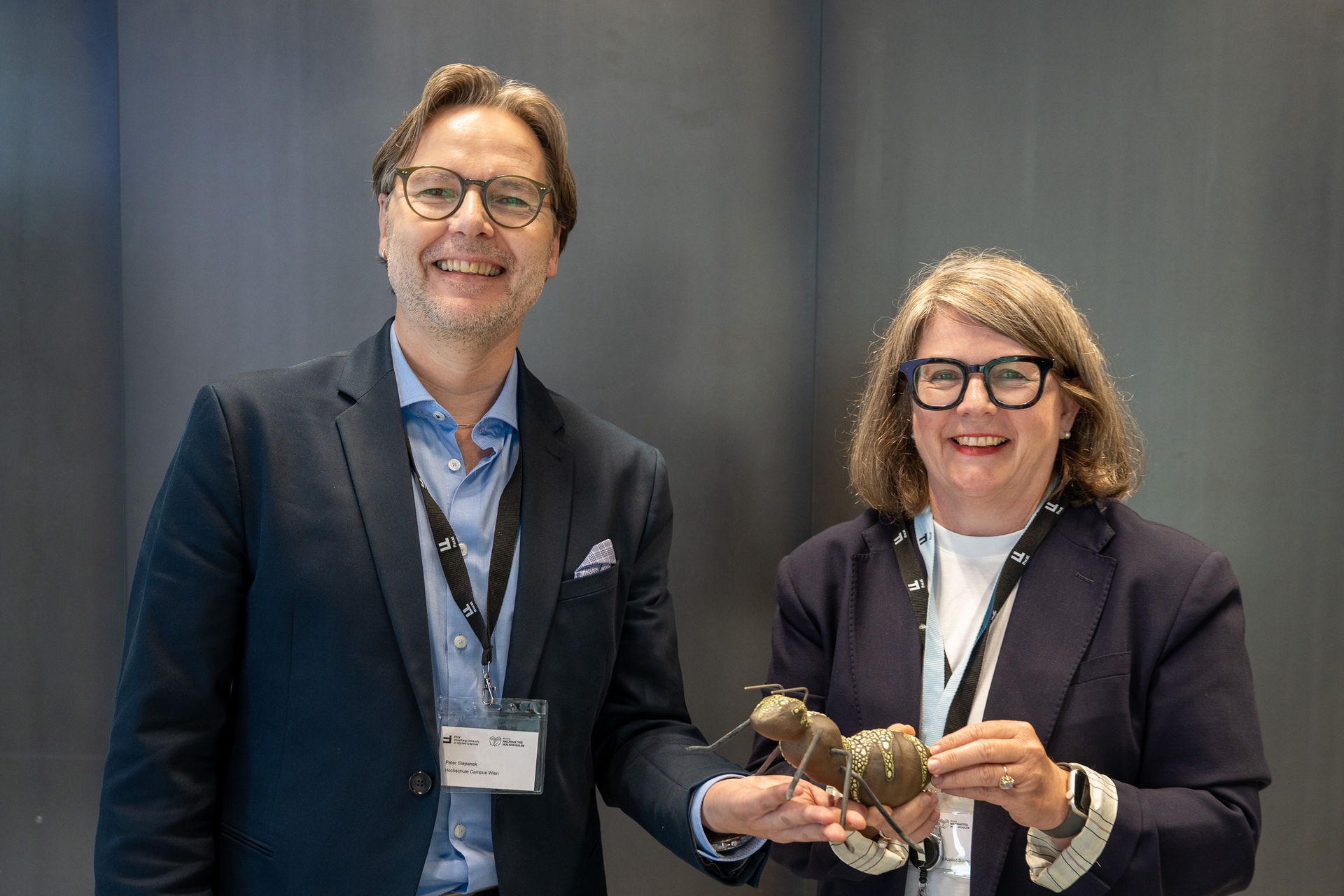
September 25 was SDG Flag Day, and to mark the occasion, the flags of the Sustainable Development Goals (SDGs) were raised around the world. The day holds special significance for the Alliance for Sustainable Higher Education*: the network is celebrating its fifth anniversary. In an interview, co-chairs Beate Pawle (FHV) and Peter Stepanek (Campus Wien University of Applied Sciences) reflect on the collaboration, past successes, and future goals.
The Alliance for Sustainable Universities is celebrating its fifth anniversary. FHV has been a part of it from the very beginning. What have you accomplished together since then, and what successes can you celebrate?
Beate Pawle: Over the past five years, an initiative by dedicated colleagues has grown into a strong network of 15 universities of applied sciences. Through working groups, networking meetings, annual conferences, Sustainability Day, and the Summer Academy, we share experiences, develop solutions together, and make successful approaches accessible to everyone. For me, a key success is the culture of collaborative learning that has emerged. Sustainable transformation is complex and involves conflicting goals, uncertainties, and differing perspectives. That’s why, in addition to expertise, we also need openness, tolerance for ambiguity, and a willingness to learn from one another rather than competing for the one “right” solution.
Peter Stepanek: The alliance is a best practice that demonstrates how we can collaborate on an issue beyond the boundaries of our universities. We are not competitors; we see ourselves as partners who can achieve more together, motivate one another, and learn from each other. That is not something to be taken for granted. The founding generation has handed us a valuable initiative, and we are continuing to build upon a strong foundation.
What has happened in the area of sustainability specifically at the FHV over the past five years?
Beate: At the FHV, sustainability has evolved from individual measures into a university-wide cross-cutting issue. Sustainable development is increasingly being embedded in teaching, research, knowledge transfer, governance, and university operations. My personal highlight was the first FHV Sustainability Day this year. It made visible and tangible what sets sustainability at the FHV apart: collective action, interdisciplinary collaboration, and the exchange of diverse perspectives. Students, lecturers, researchers, and staff contributed their projects, initiatives, and ideas, learned from one another, and generated new momentum. I was particularly pleased by the openness, commitment, and joy in designing the future together. The day demonstrated that sustainable development emerges through dialogue and the collaboration of many stakeholders.
What goals are you pursuing for the future as an alliance and specifically at the FHV?
Beate: As an alliance, we want to further specialise our collaboration, expand our offerings for member universities, and strengthen our impact and visibility. Close networking enables us to share knowledge, learn from one another, and jointly develop viable solutions for a livable future. At the same time, in line with the Third Mission, the goal is to bring knowledge and research findings more strongly into the public dialogue—such as in pursuing the SDGs beyond the year 2030—to raise awareness of sustainable development, and to initiate processes of change together with politics, Business and Management, and civil society. At FHV, we aim to embed sustainability even more consistently across all social fields of action. Our students should learn to view complex challenges from a systemic perspective, incorporate different viewpoints, and deal constructively with uncertainties and contradictions. To me, future-oriented competence means tolerating ambiguity and developing new courses of action across disciplines and sectors of society. At the same time, we want to raise the profile of our activities, raise public awareness of sustainability, and further expand our engagement with the region.
Peter: The socio-ecological transformation requires perseverance and fruitful collaborations—both within the higher education sector and beyond. Another goal is to encourage universities of applied sciences (FHs/HAWs) that are not yet represented in the alliance to join. It would also be great if we could convince the colleges of education to get involved with the Alliance. We also want to play an active role internationally. We’re working to be recognized as partners in both the political sphere and civil society.
Thank you for the interview!
Key figures for the Alliance for Sustainable Universities since its founding five years ago:
- 55 online meetings (working groups, networking events, workshops) with approximately
- 1,100 participants from teaching, research, and university administration
- 15 universities with 58,230 students (2024/25)
- 5 Sustainability Days with 60 presentations
- 4 Alliance congresses featuring 60 keynote and technical presentations and 265 participants
- 3 international summer schools on biomimicry with 75 students from 8 countries
More information about the FHV as a sustainable university can be found here.