Master's degree
Mechatronics – Research & Development
In the part-time Mechatronics – Research & Development master’s degree, you’ll learn to solve technical challenges and independently lead interdisciplinary research and development projects. You’ll combine advanced expertise in mechatronics with scientific methods and a broad, cross-disciplinary understanding.
Facts
 |
Degree: Master of Science in Engineering (MSc) |
 |
Format: part-time |
 |
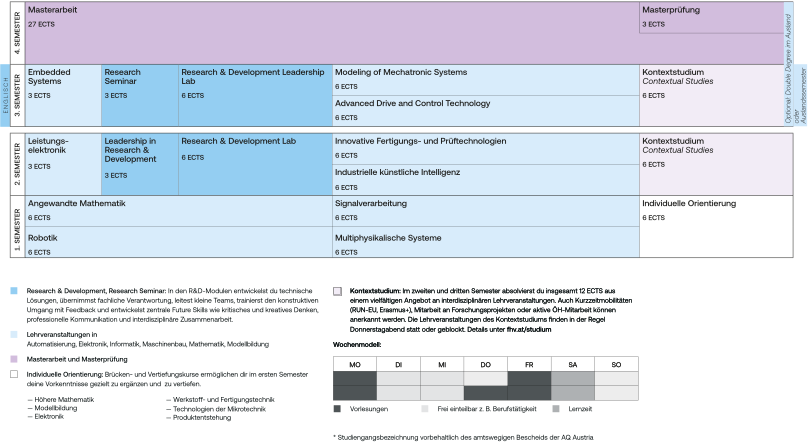
Duration: 4 semesters | 120 ECTS |
 |
Language: German (B2) | English (B2) |
 |
Study abroad: optional |
 |
Costs: currently no tuition fee |
 |
Programme start: 1st September |
 |
Application start: 15th November |
Why study Mechatronics – Research & Development at FHV?
Part-time study
Continue working up to 60 % and apply your knowledge directly in your professional practice.
Research & development
Combine mechanical engineering, electronics and computer science to develop solutions to complex technical challenges in research and industry.
Leadership skills
Lead projects and teams and take on technical responsibility when working with industry partners.
State-of-the-art labs
Work in modern laboratories and small research groups in a practical product development environment.
In this degree, you’ll learn to
- deepen your expertise in mechatronics using scientific methods
- solve complex technical challenges
- develop innovative solutions for industrial applications
- independently lead research and development projects
The detailed curriculum will be available shortly.
Testimonials and practical examples


Your career opportunities
Job opportunities in the areas of
-
Research and development and technical leadership
-
Project management and complex systems development
-
Product development and technological innovation
-
Robotics, embedded systems and industrial digitalisation
-
Simulation, optimisation and sustainable systems development
-
Production and automation engineering
-
Artificial intelligence in technical applications
Further study opportunities in Austria and abroad
The degree also provides access to further academic qualifications, such as a doctoral or PhD programme at a technical university.
A Master’s degree programme in Mechatronics at the FHV requires the following qualifications or competencies:
- Completion of a relevant FHV Bachelor's degree programme (Mechatronics, Electrical Engineering Dual, or Electronics and Information Technology Dual) or
- Completion of a fully equivalent degree or of a degree at NQR Level 6 (Bachelor’s)
The prior studies should include at least the following areas:
| Minimum number ECTS | From each of the following subject areas |
| 12 | Calculation, dimensioning and optimisation in Electrical Engineering and Electronics |
| 12 | Calculation, dimensioning and optimisation in Mechanical Engineering |
| 6 | Programming |
If equivalence according to the table above is fundamentally given and only certain elements are missing for full equivalence, the programme director is authorised to determine equivalence with the condition of additional examinations, which must be completed before the start of the Master’s degree programme in Mechatronics.
For admission, proof of language proficiency at level B2 in both German and English (according to the Common European Framework of Reference for Languages) is required.
FHV's application periods are structured as follows:
Application Period I: 15 November – 1 March
Apply by 1 March to benefit from an early admission decision.
Application Period II: until 31 May
You can apply for all study programmes regularly until 31 May.
Application Period III: until 15 August
Some programmes may still offer individual places until 15 August.
Important information: The application deadline for applicants from third countries (non-EU/non-EEA, except Switzerland) is 1 March.
Two steps to your desired degree at FHV:
Step 1:
Review of the submitted documents and assessment of the admission requirements.
Step 2:
In a personal interview, we get to know you better – your goals, your motivation, and your reasons for choosing this degree programme.
Verified academic achievements from master’s programmes at universities and universities of applied sciences may be credited on an individual basis towards specific courses or modules. The decision on recognition rests with the programme director.

Why FHV?
Practice-oriented
Combining theory and practice from day one
Personal
Small study groups and individual support
Interdisciplinary
Developing solutions together across disciplines
International
100+ partner universities and membership of RUN-EU ▷ More
Future Skills
Combining subject knowledge with essential future skills ▷ More
Frequently asked questions
Yes. We recommend working 60–80% alongside your studies.
Lectures and exams usually take place on Mondays, Fridays and on selected Saturdays.
The programme is divided into half-semesters. You’ll generally take three exams per half-semester, spreading your assessments across the semester.
The master’s programme is open to graduates from a range of engineering and technical bachelor’s programmes. The Individual Orientation process helps determine your academic background together with the programme director. If necessary, an individual study plan is agreed to address any gaps in your knowledge. This ensures that all students start the master’s programme with the necessary subject-specific foundations.
The third semester is taught entirely in English. This helps you strengthen your technical English skills and prepares you for international collaboration in research and development.
Yes, a double degree is possible as part of the Mechatronics - Research & Development master’s programme through a partner university. You study at two universities in different countries and, upon successful completion, earn two academic degrees. This gives you international study experience and strengthens your career prospects in the global job market.
- Successfully complete all courses in the curriculum (Exam regulations and grading system).
- Receive a passing grade for the Master's thesis.
Upon successful completion of the degree, you will be awarded the academic title Master of Science in Engineering (MSc).
- Qualification level according to the national and European Qualifications Frameworks: Master's degree (second cycle)
- Field of study according to ISCED-F: Code 00714 – Electronics and automation
Do you still have questions?
You can contact us directly Monday to Thursday from 09:00 AM - 11:30 AM or by individual appointment.


