Bachelor's degree
Computer Science – Software & Information Engineering
In the Bachelor's degree programme in Computer Science – Software & Information Engineering, you will develop innovative software solutions for the digital world. You will combine in-depth knowledge of computer science with current technologies and methods such as artificial intelligence, cloud computing and DevOps, learning how to apply them as part of professional software development.
Facts
 |
Degree: Bachelor of Science in Engineering (BSc) |
 |
Format: full-time |
 |
Duration: 6 semesters | 180 ECTS |
 |
Language: German (B2) | English (B2) |
 |
Study abroad: optional |
 |
Costs: currently no tuition fee |
 |
Programme start: 1st September |
 |
Application start: 15th November |
Why Computer Science – Software & Information Engineering at FHV?
More than code
Learn to develop powerful software solutions from end to end – from requirements analysis and architecture to deployment and operation.
Software for the future
Use AI effectively as a tool and develop solid software engineering skills to build complex software systems.
Hands-on experience in the tech industry
Collaborate with companies on practical projects and site visits, gaining valuable hands-on experience while you study.
State-of-the-art labs
Make use of the fully equipped IT labs, available 24/7, to develop, test and optimise software in a professional development environment.
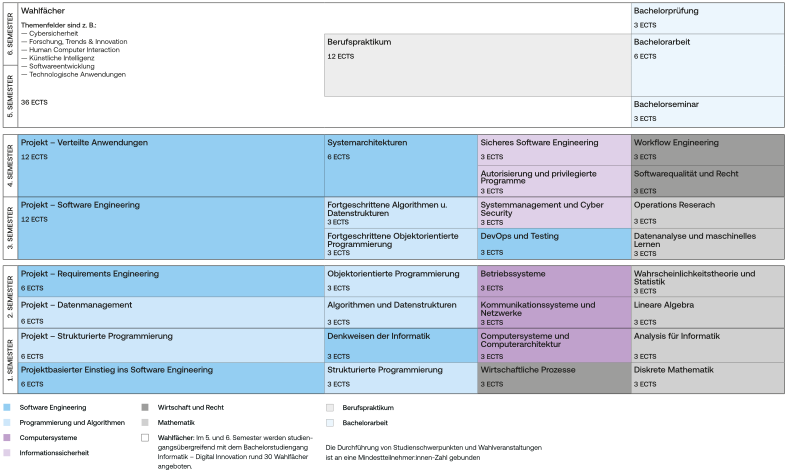
In this degree programme, you will learn to:
- Develop modern software solutions using AI and agile methods
- Apply different programming techniques, algorithms and data structures
- Design databases and store data efficiently and securely
- Understand modern computer systems and networks
- Apply machine learning and AI
- Combine technical and business perspectives
The detailed curriculum will be available shortly.
Testimonials and practical examples from their studies


Your career opportunities
Job opportunities in the areas of
- Software Engineering and Software Development
- Software Architecture
- Software Product Management
- Information Security
- Cloud Engineering and DevOps
- Data Science and Data Engineering
- Research and Innovation
Further study opportunities in Austria and abroad
Master programmes at FHV:
The Bachelor's degree in Computer Science - Software & Information Engineering requires the following qualifications:
- General university entrance qualification, or
- Relevant professional qualification with additional examinations
For this degree programme, relevant professional qualifications include the completion of any apprenticeship or vocational secondary school programme with a training period of at least three years, or a comparable vocational qualification in terms of scope and requirements, which includes technical and/or commercial components in its curriculum.
The programme director decides whether a qualification is deemed relevant. Applicants with a relevant professional qualification must successfully complete the additional examinations at FHV.
For admission, proof of language proficiency at level B2 in both German and English (according to the Common European Framework of Reference for Languages) is required.
The application deadlines at FHV are as follows:
Application Period I: 15 November – 1 March
Apply by 1 March to benefit from an early admission decision.
Application Period II: until 31 May
You can apply for all study programmes regularly until 31 May.
Application Period III: until 15 August
Some programmes may still offer individual places until 15 August.
Note: The application deadline for applicants from third countries (non-EU/non-EEA, except Switzerland) is 1 March.
Two steps to your desired degree programme at the FHV:
Step 1:
Assessment of your complete application documents, your previous education and experience.
Step 2:
In a personal interview, we find out more about you, your goals and your motivation for the degree programme.
As a high school graduate from a higher vocational school (HTL, HAK), individual courses can be recognized individually during your studies. You will receive details about this in a discussion with the programme director.

Why FHV?
Practice-oriented
Combining theory and practice from day one
Personal
Small study groups and individual support
Interdisciplinary
Developing solutions together across disciplines
International
100+ partner universities and membership of RUN-EU ▷ More
Future Skills
Combining subject knowledge with essential future skills ▷ More
Frequently asked questions
Ja. Student jobs are possible alongside your studies, depending on your timetable.
Lectures and exams usually take place Mondays to Fridays between 8:00 AM and 5:00 PM.
Study abroad:
- A semester abroad is possible in the 5th semester, depending on the availability of places at partner universities.
- Short-term study abroad opportunities are also available, for example through RUN-EU.
Internship:
- A compulsory professional internship in the 6th semester (10 weeks).
No prior knowledge is required. However, the learning curve in programming is steep during the first two semesters, so a genuine interest in the subject and a willingness to put in the effort are important.
If you have graduated from an HTL (Higher Technical Institute), you may be eligible to enter directly into the second or third semester. Find out more in the admission requirements.
Both Bachelor's degree programmes provide a solid foundation in computer science and software development. However, they have different areas of focus. Software and Information Engineering is more technically oriented, focusing on the development of software, information systems and IT infrastructures. Digital Innovation combines computer science and software development with business administration and innovation management. The focus is on developing digital products and services and optimising business processes.
- Successfully complete all courses in the curriculum (Exam regulations and grading system).
- Receive a passing grade for the Bachelor's thesis.
Upon successful completion of the degree, you will be awarded the academic title Bachelor of Science in Engineering (BSc).
- Qualification level according to the national and European Qualifications Frameworks: Bachelor's degree (first cycle)
- Field of study according to ISCED-F: 0613
Do you still have questions?
You can contact us directly Monday to Thursday from 09:00 AM - 11:30 AM or by individual appointment.


