FHV kicks off the academic year with a focus on the future
08.09.2026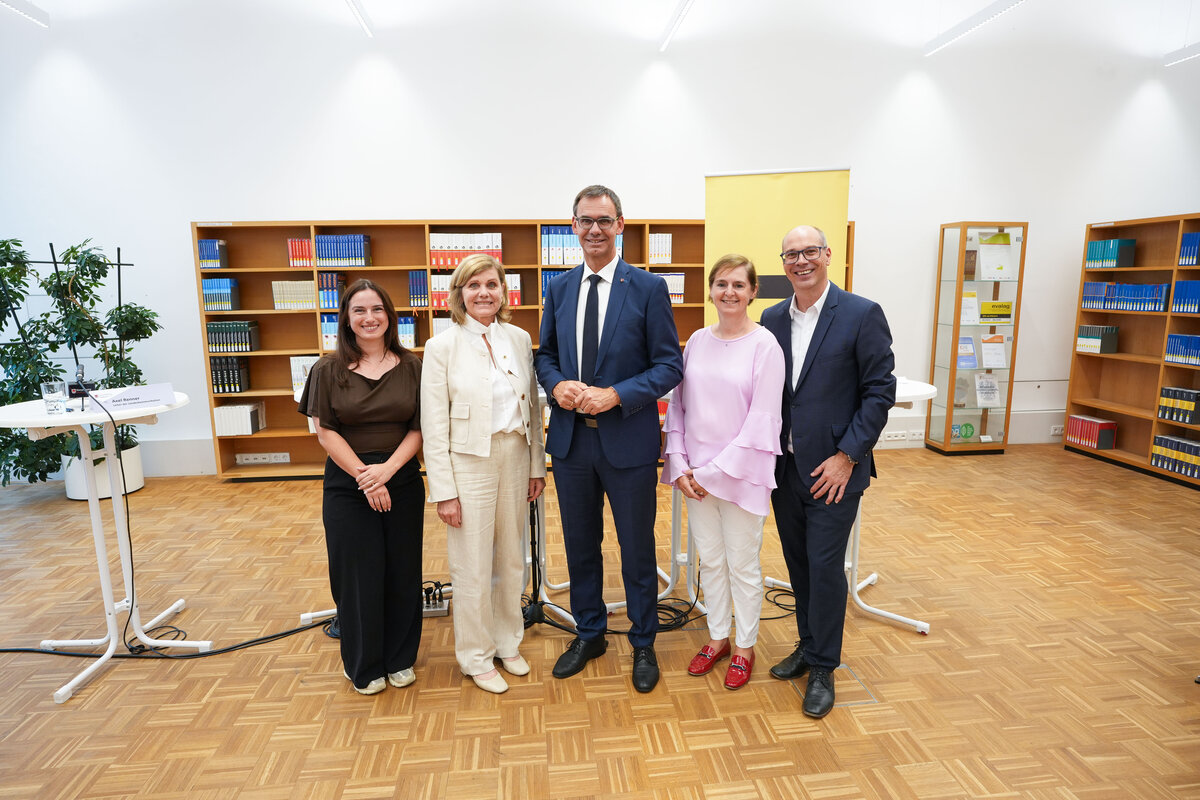
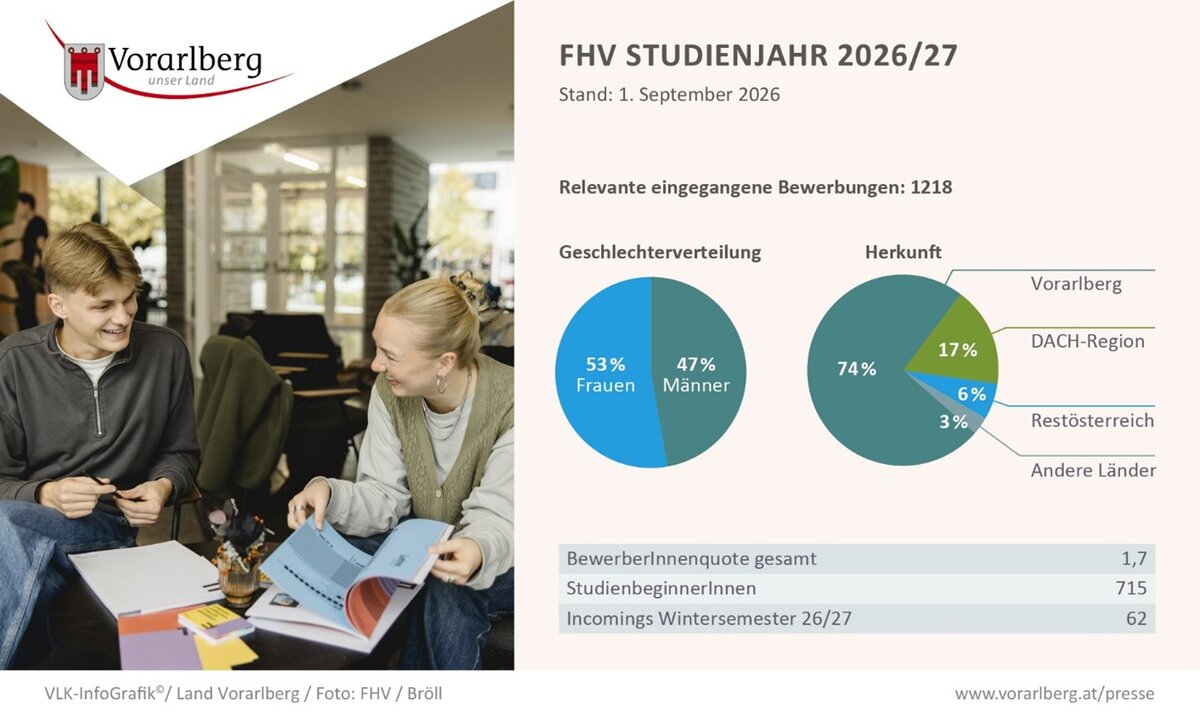
The FHV is entering the new academic year with a practical and forward-looking approach. Future skills and a reflective approach to artificial intelligence have been systematically integrated into the curricula. “The FHV is a key driver of Vorarlberg’s future: It trains skilled professionals, provides strong impetus for innovation, and strengthens our position as a hub for Business and Management. With the joint orientation week, the option for a dual degree programme, and a clear focus on future skills, the university demonstrates how modern, practical education succeeds,” said Governor Markus Wallner and State Secretary for Education Barbara Schöbi-Fink.
The FHV is and will remain the university that educates and conducts research for the social, economic, and scientific landscape of Vorarlberg. It offers more than 20 degree programmes in Engineering and Technology, Business and Management, Design, as well as Social Work and Health. As of September 1, the university had received 1,218 applications, 53 percent of which were from women. On average, there are 1.7 applicants per available spot, meaning demand remains at the high level of the previous year. About 80 percent of first-year students are from Vorarlberg. While numerous bachelor’s and master’s students are currently taking their final examinations at the university and will celebrate their graduation in October, 715 people have been accepted and are now starting the new academic year. “We are very pleased with the high level of interest in our technical bachelor’s degree programmes: This year, we’ve seen a record high in applications for these programmes. Among the master’s programmes, International Management and Leadership is particularly in demand,” reports FHV Managing Director Stefan Fitz-Rankl. There are also high numbers of applications for the bachelor’s programmes in Health Care and Nursing, Social Work, International Business Administration, and Computer Science—Digital Innovation, as well as for the master’s programme in International Business Administration—Sustainable Management with a specialisation in Finance & Controlling. 74 percent of all applicants come from Vorarlberg, 17 percent from the DACH region, 6 percent from the rest of Austria, and 3 percent from other countries.
High Quality of Academic Programmes
FHV stands for high-quality academic education with a strong practical focus. This is confirmed by the latest CHE university ranking* (Center for Higher Education Development), which has been the most comprehensive and detailed university ranking in the DACH region for over 25 years. Governor Markus Wallner comments: “FHV demonstrates how highly qualified professionals are trained in Vorarlberg through practice-oriented and future-focused programmes. What makes Vorarlberg University of Applied Sciences particularly strong is the close link between academia and Business and Management.” The bachelor’s programmes in Social Work, International Business Administration, and Engineering and Management achieved top ratings of up to 4.6 out of five stars in the ranking, placing them well above the average of participating universities in the German-speaking region. The programmes received particularly high ratings for their practical focus, organizational structure, course offerings, and support from lecturers. “It is also particularly encouraging that nearly 100 percent of the students surveyed graduate within the standard period of study,” emphasizes FHV Rector Regine Kadgien. Quality in teaching also means preparing students for the demands of tomorrow.
Integrating Future Skills
Artificial intelligence is fundamentally changing how knowledge is taught, acquired, and applied. The FHV is actively embracing this transformation and consistently refining its curricula. Interdisciplinary cooperation and collaboration are among the core “future skills” taught to students at the FHV. Solid subject-matter expertise remains the indispensable foundation of the programme, but it is specifically combined with future skills and the competent use of AI. “Instead of merely reproducing knowledge, the focus is shifting more toward understanding, critical analysis, and the ability to use AI in a reflective and purposeful manner. At the same time, skills such as critical thinking, creativity, digital literacy, collaboration, and a sense of ethical and social responsibility are gaining in importance. It is precisely these future-oriented skills that we impart to our students and combine them with subject-specific knowledge and concrete practical application,” explains FHV rector Regine Kadgien. For while AI will transform job profiles and take over repetitive tasks, human skills such as critical thinking, creativity, collaboration, and communication will continue to grow in importance. For the FHV, however, future-readiness means not only further developing degree programmes and teaching but also strengthening applied research and academic career paths this academic year as well.
Dual Study Programmes
Dual study programmes — such as those offered in the bachelor’s programmes in Electronics and Information Technology, Engineering and Management, Mechatronics, and Computer Science — Digital Innovation — are attractive to both students and companies. Students spend two days a week at the FHV and work three to four days at a company. “The close integration of academic study and professional work combines up-to-date scientific expertise with valuable practical experience. At the same time, companies gain qualified young professionals whom they can prepare specifically for their needs,” explains FHV Rector Regine Kadgien. Interested companies can learn more about partnerships at the Dual Forum at the FHV on September 24.
Click here for the complete press kit.