RUN-EU brings Europe into the vacation itinerary
25.09.2026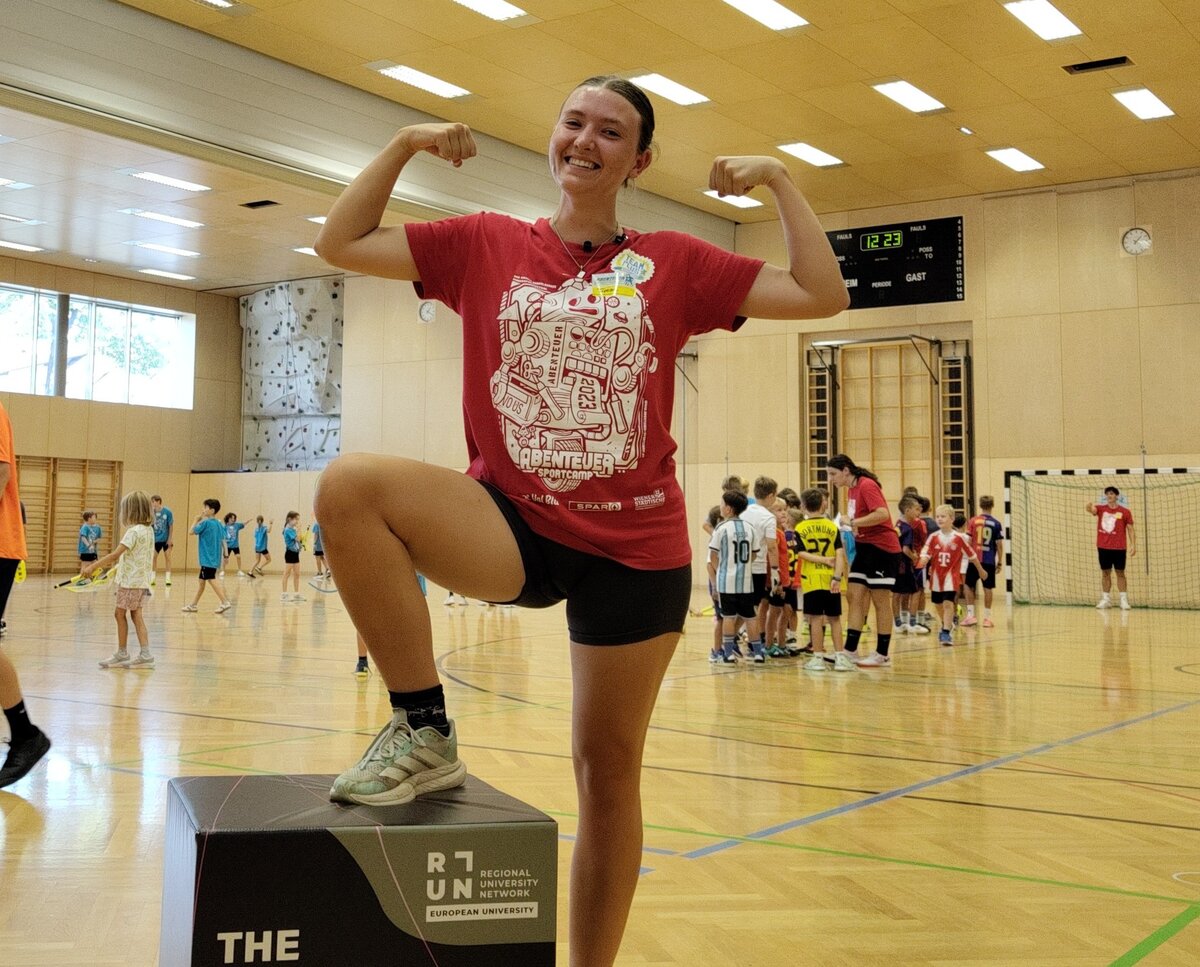
Key Takeaways
- International volunteers spent two weeks helping with summer programmes for children in Vorarlberg.
- Three local partners made the FHV’s first international volunteer program possible: the Abenteuer Sportcamp, W*ORT Lustenau, and the city of Dornbirn.
- Bridging languages and cultures: Children, caregivers, and students benefited from the exchange and forged new connections.
This summer, 14 international students from six of the FHV’s partner universities and three students from Austria spent two weeks volunteering in summer programs for children in Vorarlberg as part of the Regional University Network – European University (RUN-EU). The network connects ten European universities with the goal of strengthening international cooperation, mobility, and intercultural exchange. “International volunteering creates learning environments that we cannot replicate in any seminar. Students must engage with new people, cultural differences, and unfamiliar situations, and in doing so, they learn a great deal about themselves. At the same time, the European spirit of RUN-EU becomes a direct, tangible experience: Young people from different countries take on responsibility together and build relationships across linguistic and cultural boundaries,” summarizes Dr. Erika Engleitner-Geser, professor of Social Work at the FHV and organizer of the volunteering program. She also thanked the partners in Vorarlberg for their collaborative partnership.
Volunteers at the Adventure Sports Camp
At the Adventure Sports Camp, which drew around 2,500 children, the volunteers assisted staff members at various locations. Project manager Wolfgang Bauer was impressed: “The international students threw themselves into the work right from the start and were immediately integrated. Friendships even developed. At the camp, they were the absolute superstars.” The volunteers helped broaden horizons and energize the Adventure Sports Camp teams, which also had a positive impact on the children.
W*ORT in Lustenau and the City of Dornbirn
Other students got involved in creative activities at W*ORT in Lustenau or at the City of Dornbirn’s vacation clubs. “I think it’s valuable to learn about other cultures, other languages, and other ways of doing things,” says Maria Großkopf-Guevara from the FÜRW*ORT association. The exchange was also noticeable in Dornbirn: “The linguistic and cultural exchange was a valuable and enriching experience for both the children and the staff at the summer camp,” say Birgül Kurucam and Martina Marleku, coordinators of the City of Dornbirn’s after-school care programme.
Intercultural learning was also a key part of the experience: The students worked up to seven hours a day, managed their commute using public transportation, overcame language barriers, and experienced cultural differences in their daily work. Since no more than two international volunteers worked together at any one location, they had to step out of their comfort zones and make local connections. This also led to personal relationships and shared leisure activities.
Best Experience of a Lifetime
Feedback from the participants shows just how formative the two weeks were: Lakmali from Häme University of Applied Sciences in Finland describes it as a wonderful experience she will remember for a long time. João from the University of Leiria Oeste in Portugal even describes the volunteer experience as one of the best experiences of his life: He got to know many interesting people and places and realized for the first time that work doesn’t have to feel like work at all. Germán Blanco Loa from the University of Burgos in Spain also looks back fondly: “Stimulating the children’s imagination through creative activities was the highlight of my volunteer assignment at W*ORT for me. At the same time, I had the opportunity to get to know Austria.”
About the European Day of Languages
The European Day of Languages is celebrated every year on September 26. It was launched in 2001 as a joint initiative of the Council of Europe and the European Commission. Through this initiative, some 700 million citizens in the 46 member states of the Council of Europe are encouraged to discover and learn languages at any age, whether through formal education or outside of it. This reflects the shared conviction of the Council of Europe and the European Commission that linguistic diversity is a powerful means of promoting intercultural understanding and a fundamental part of Europe’s rich cultural heritage.


