Remote Work and Welfare Services in the Municipal Review
01.07.2026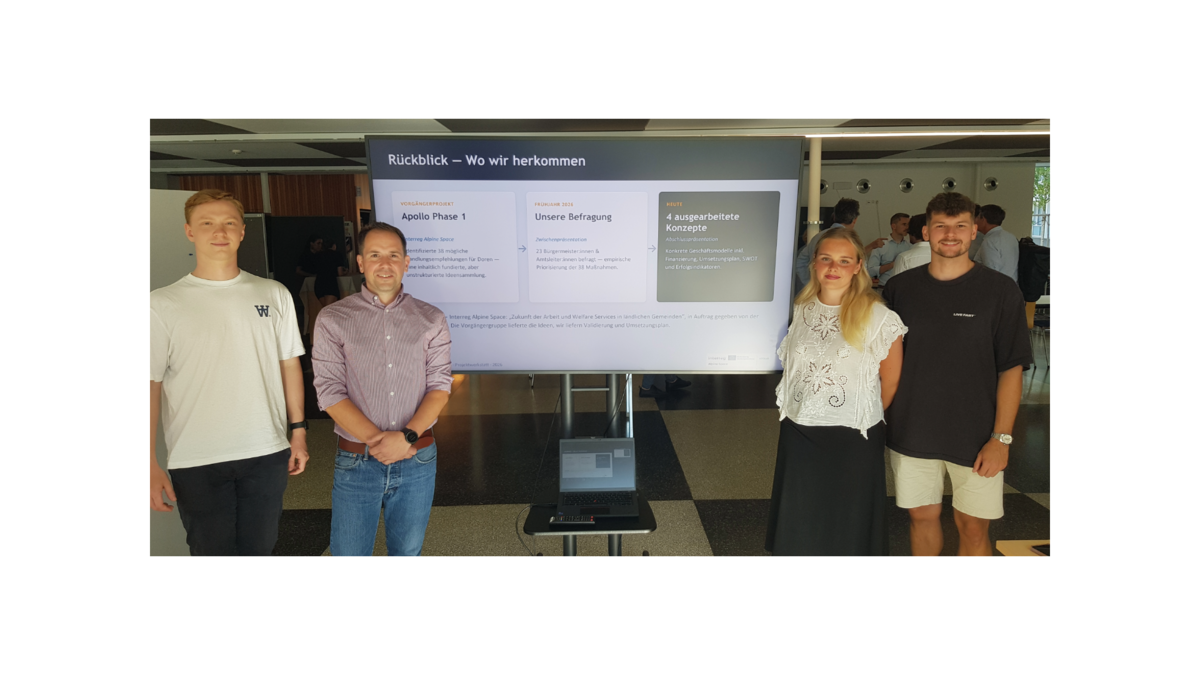
Key Takeaways
- FHV students worked with local communities to assess the feasibility of innovative concepts for the future.
- Digital citizen services and the development of digital skills won over most local community representatives.
- The findings help local communities further develop remote work and welfare services in a targeted manner.
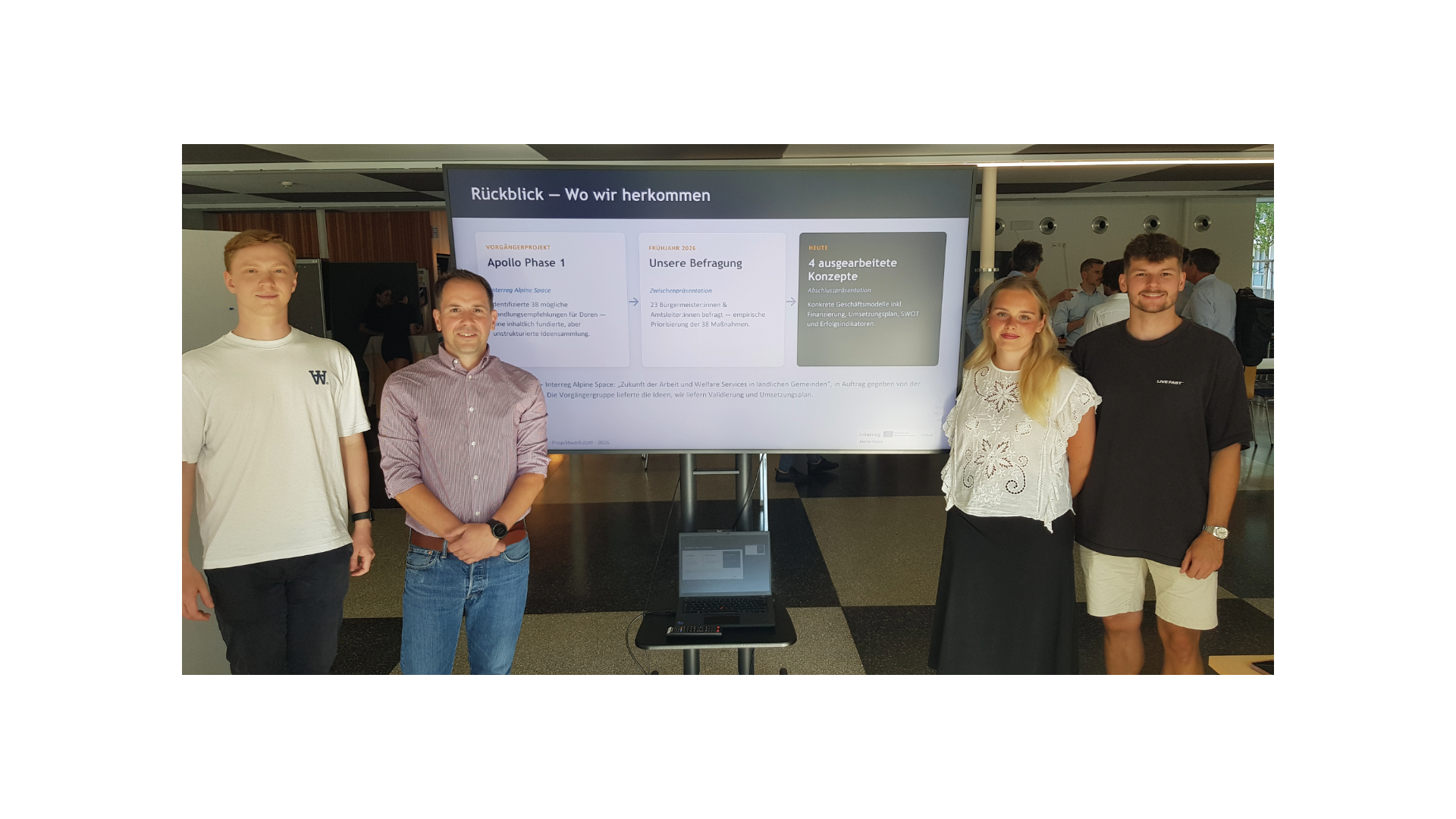
As part of the Interreg Alpine Space project Apollo, FHV students worked with the municipality of Doren last year to develop recommendations for promoting remote work and welfare services in rural communities. The goal of the current project was to test these recommendations for practical feasibility and to assess which measures municipalities can realistically implement. To this end, the team conducted interviews with mayors and department heads and supplemented these with a digital survey of additional municipalities. A total of 23 municipal representatives participated, from the Bregenzerwald, the Montafon, the Leiblachtal, the Walgau, the Rheintal, and the Lake Constance region—representing nearly a quarter of all municipalities in Vorarlberg. In addition, the team developed simulation-based financial planning, SWOT analyses, and marketing strategies for the highest-priority concepts.
Virtual Citizen Service Center
The results clearly show that measures with a direct impact on everyday life receive the strongest support. The concepts for a virtual citizen service center, as well as regular courses and workshops to strengthen digital skills, received the highest priority ratings and consistently ranked at the top across all districts. Ideas regarding job sharing across municipal boundaries and a peer-monitoring approach were also deemed relevant across districts, with both measures ranking among the top 6 in Feldkirch and Bludenz, whereas they were weighted significantly lower in the Bregenz district. More experimental approaches, such as remote work playgrounds or 24/7 childcare slots, received less support.
“The results show where municipalities can work together: stronger digital collaboration with residents and cross-municipal cooperation—for example, on job sharing or digital services—offer concrete potential for the future of rural municipalities in Vorarlberg,” said project manager Florian Maurer of the FHV.At the project’s conclusion, during the Regio meeting, the team presented the municipality of Doren and the Bregenzerwald Regio—each represented by Guido Flatz, a member of the state parliament and mayor of Doren—with a comprehensive report containing prioritized and economically evaluated recommendations for action. The results are intended to support municipalities in gradually implementing remote work and modern welfare services.
FAQ
What is the APOLLO project?
APOLLO is a research project funded by Interreg Alpine Space. It examines how digitalization, remote work, and welfare services can improve the quality of life and work in the Alpine region.
What contribution did the FHV students make?
The students examined the practical feasibility of previously developed recommendations for action and, together with municipalities in Vorarlberg, evaluated them in terms of priority and cost-effectiveness.
Which measures did the municipalities consider particularly relevant?
A virtual citizen service center and programs to promote digital skills received the highest level of support. Inter-municipal job sharing was also viewed positively.
How do municipalities benefit from the results?
The final report provides prioritized and economically evaluated recommendations for action that support municipalities in the gradual introduction of remote work and modern welfare services.


