"Removing poverty from anonymity"
07.01.2026
The 4th Social Space Conference will take place on January 16 at the FHV. The event will focus on the topic of poverty. Does poverty exist in such a rich country as Austria?
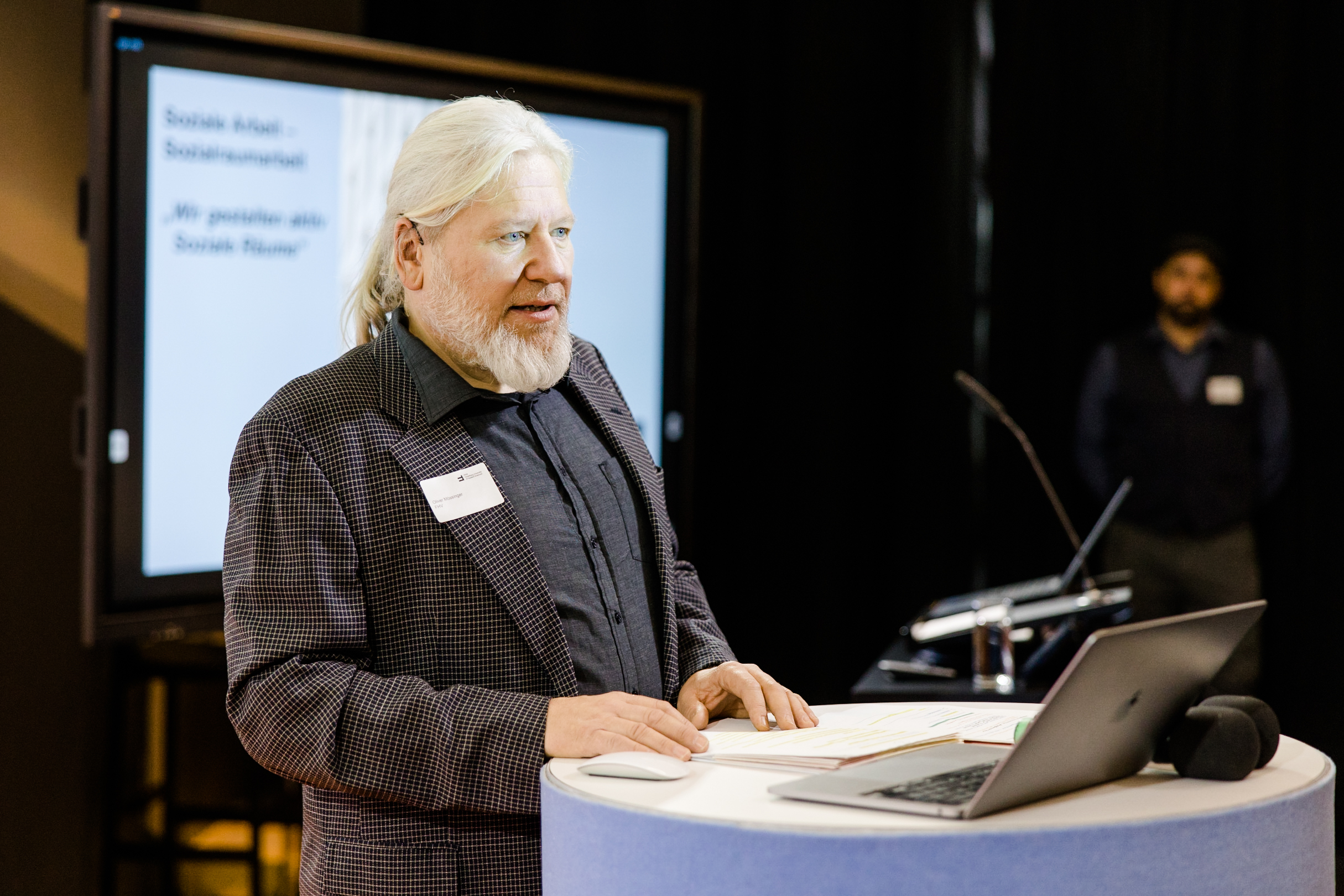
Oliver Mössinger: When planning this event, it was already clear to experts in Social Work that current developments could not ignore the problem of the risk of poverty in the land of prosperity. The global economic crisis, the time around and after Corona, the ongoing inflation, the tariff and trade war and various geopolitical crises led to the domestic Business and Management weakening, resulting in above-average inflation. All of this means that Austria, the federal government, the federal states and local authorities are now forced to make savings. The proclaimed slogan "everyone must do their bit" is now also affecting those in our society who already have little to live on. This increases the existing risk of poverty in Vorarlberg. This is confirmed by recognised studies.
Can this risk of poverty be quantified?
Mössinger: Measured against the total population, a comparatively large number of people in Vorarlberg are at risk of poverty or exclusion. In Vorarlberg, every fifth person* is at risk of poverty or exclusion. What is new is that the search for the missing money is now also affecting the social economy in Vorarlberg. This development will also be felt by customers of social institutions in the near future. What is the aim of the Social Spaces Conference? Mössinger: With the FHV's Social Space Conference, we address current issues in the Vorarlberg social space, focus on urgent socio-political issues and bring social work students together with interested citizens, politicians, administration and social services. Together, we analyze living conditions and social problems in Vorarlberg, look for solutions and, ideally, activate resources.
What personal goal are you pursuing with the social space conference?
Mössinger: It is important to me personally that we promote a holistic view with the social space conference and provide a framework for constructive discussions and possible answers for improvement in the Vorarlberg social space. Ideally, innovative solutions to problems or realistic approaches to alleviating problems are identified. This promotes social participation. In conclusion, it is about concrete approaches to the challenge of poverty and accessibility.
How do FHV students benefit from this?
Mössinger: We are creating a real-life training platform for students of the Master's degree in Social Work with a specialization in social space work, a kind of helpers' conference with large groups of people.
What can visitors expect at the 2026 event?
Mössinger: Based on professional definitions, the poverty situation in Vorarlberg will be highlighted and concrete social work offers in the area of livelihood security will be presented with contributions from the ifs debt counseling service and Caritas. Accompanying this, the exhibition "Poverty has a face" and a fishbowl discussion will bring poverty out of anonymity. Experts from Social Work, civil society and the student body will discuss the possibilities and limits of existing services, with the audience also actively involved. The conference will be complemented by a poster exhibition by bachelor students on community work.
The entire social system in Vorarlberg is currently under severe pressure due to the threat of cuts. The state and municipalities want to pay around 15 million euros less into the social fund in 2026. How do you see this development?
Mössinger: The current situation gives the impression that this "crisis" has hit Vorarlberg like an unforeseeable natural event and without prior notice, e.g. like a quake followed by a tidal wave without a tsunami warning and without any possible alternative action plan. This was and is not the case. We can manage turbulent times and difficult challenges more professionally!
And how?
Mössinger: Social Work experts are excellently trained and have mastered constructive social planning. For this reason, we addressed the topic of "regional development and combating poverty" back in the summer when we were preparing for the Social Spaces Conference 2026. Constructive social planning is, among other things, an essential part of Social Work training, especially in the Master's degree with its specialization in social space work. The setting of a social space conference brings together different players from social policy and the social economy and promotes, among other things, a dialog based on solidarity and jointly supported solutions to problems. Ideally with foresight and in the long term, as well as during a crisis.
State Councillor Martina Rüscher and Caritas Director Walter Schmolly will also be guests?
Mössinger: Yes, after a constructive outlook and a reading followed by a discussion about social participation, tax justice and necessary political measures against poverty and the risk of poverty in Vorarlberg, there will be a moderated discussion with State Councillor Martina Rüscher and Caritas Director Walter Schmolly about necessary measures against poverty and the risk of poverty.
What does the profession of Social Work mean to you?
Mössinger: Social Work and the education of our students are close to my heart. Prospective Social Workers have consciously chosen this beautiful but also extremely demanding profession in the social sector. These people take on responsibility and are professionally committed to those they serve in our society. They are often the link to peaceful coexistence, sometimes even when we as a society lack understanding and/or look the other way. They have received an excellent education and deserve our recognition. As a lecturer at the FHV, I can make my contribution and accompany these colleagues on their way into Social Work, I hope as a role model.
A brief look back at your own career?
Mössinger: My own studies, which I was able to complete 30 years ago at the Social Academy (SOZAK) in Bregenz, sparked my interest in social justice, social policy and Social Work. A few years later, I was able to sharpen my profile - Social Work as a discipline and profession - in the course of my Master's degree in Social Work at the FHV. I was able to meet wonderful and committed people on my Social Work journey. These role models still influence my actions today.
Among other things, you volunteer for the street newspaper Marie. Can you give us an insight into this?
Mössinger: Today, I am in a privileged position and my knowledge is in demand, and I am asked for my expertise or simply for advice by a wide variety of social institutions and stakeholders. I usually have an open ear and this commitment led me, among other things, to the street newspaper marie, which sees itself as a mouthpiece for the concerns of marginalized groups in our society. The marie is a self-help service for people living on or below the poverty line in Vorarlberg. The aim is to promote cooperation between people on the margins of society and the majority society. This goal is in line with my ideals, which is why the marie is now one of my favorite projects. The varied work in this small and motivated team is meaningful and gives me pleasure. As treasurer of the marie, I am responsible for the finances on a voluntary basis.
Thank you very much for the interview.
The social space conference will take place on Friday, January 16 from 2:00 pm at the FHV in the auditorium. Participation is free of charge. Further information and registration can be found here.
*Social inequality and risk of poverty in the Lake Constance region, in the VN (Empirical Social Sciences research groups FHV): Vorarlberg online from 14.11.2025